





How do you protect steel when temperatures reach 325°C?
Most coatings aren't designed to deal with extreme temperatures.
That's what made this project for BASF particularly interesting.
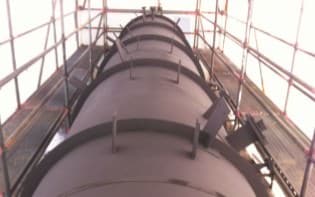
The industrial heat exchanger needed a coating capable of handling temperatures of up to 325°C, while also providing protection against corrosion.
That combination creates a difficult challenge.
High temperatures can place enormous demands on a coating, and choosing the wrong product could lead to premature breakdown and expensive maintenance.
The PPG solution
PPG was selected to provide a specialist high-temperature coating solution for the heat exchanger.
Before application, the vessel was blasted to create the required surface condition and support coating adhesion.
A single-component, surface-tolerant coating was then applied to provide temperature resistance and corrosion protection.
The project demonstrates why coating selection should always begin with understanding the actual operating conditions.
A standard protective coating may work perfectly in an ordinary industrial environment.
Put that same coating onto equipment operating at hundreds of degrees, however, and it's a completely different story.
The bigger picture
Heat exchangers, processing equipment and industrial assets operating at elevated temperatures require specialist thinking.
The coating isn't selected simply based on the substrate.
You also need to consider:
- Operating temperature
- Corrosion risk
- Existing substrate condition
- Surface preparation
- Application requirements
- Future maintenance access
When the temperature rises, the coating specification needs to rise to the challenge too.
Industrial Coatings Ltd supplies specialist protective coatings for demanding industrial environments, including high-temperature and corrosion protection applications.
